GLOBAL Anything and everything Global related

Global

13-year-old Afghan boy publicly executes murderer; 80,000 spectators

SPOTLIGHT | A snapshot into big stories

Curated content straight to your inbox.

Subscribe to our newsletter today

Global

13-year-old Afghan boy publicly executes murderer; 80,000 spectators

A 13-year-old Afghan boy publicly shot and killed the man who murdered his family, in an execution carried out under Taliban rule and witnessed by a crowd of over 80,000 people in Afghanistan’s southeastern Khost province.

According to foreign reports, a huge crowd of men filled a sports stadium to watch the execution, which human rights activists condemned as inhuman and cruel. The Taliban barred spectators from bringing camera phones, but footage recorded from outside the stadium showed tens of thousands gathered for the spectacle.

The man, identified as a resident of Paktia province, was convicted along with two others of killing 13 members of the boy’s family, including women and children. 

Afghanistan’s three-tier court system, the lower court, the appeals court, and the Supreme Court, upheld the death sentence, and Taliban supreme leader Hibatullah Akhundzada gave final approval.

According to the Supreme Court, relatives of the victims were offered the option to forgive the convicted man, which would have spared his life. They refused, choosing the death penalty. 

Khost police spokesperson Mustaghfir Gorbaz said the execution was carried out by a family member of the victims.

The Supreme Court said prayers were offered at the end of the gathering, calling for stronger national security, improved access to justice, and strict implementation of Islamic law.

Executions for two other men convicted in the same case are pending because all heirs of the victims were not present. 

This marks the 11th execution since the Taliban returned to power and reinstated their hardline interpretation of Sharia, under which crimes such as murder, adultery and theft can result in execution, amputation or flogging.

Since taking over in 2021 after the withdrawal of US and NATO forces, the Taliban have also banned Afghan women and girls from secondary school, universities and most jobs.

Global

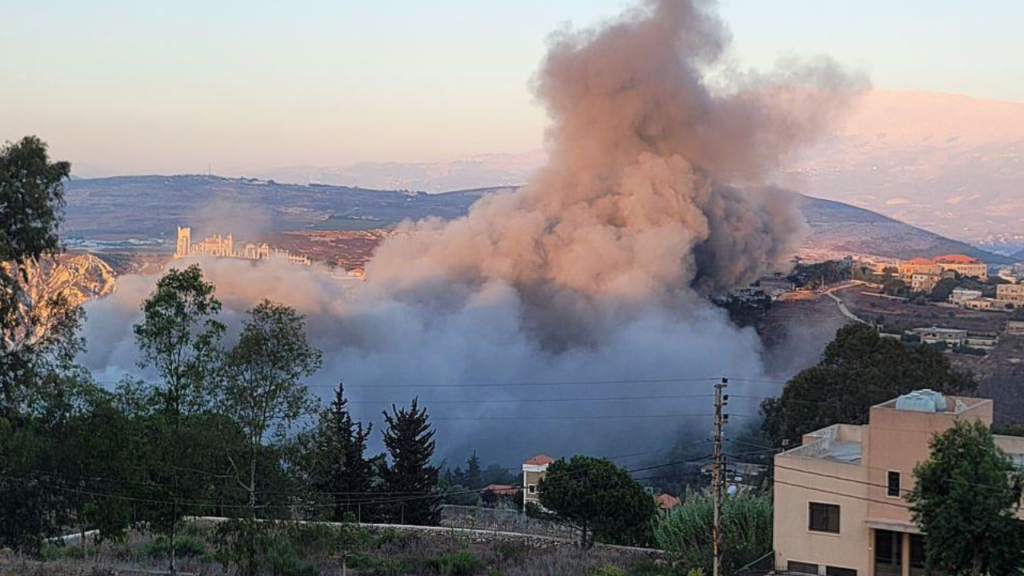
Israeli strikes resume despite direct talks with Lebanon

Israeli aircraft targeted areas in southern Lebanon on Thursday, following a rare in-person meeting between Israeli and Lebanese officials the previous day.

The airstrikes focused on locations that the Israeli military alleged were used by Hezbollah for weapon storage.

Residents living in Mjadel, Baraachit, Jbaa, and Mahrouna received orders to evacuate areas close to what Israel identified as storage sites associated with Hezbollah. The Israeli military stated that these locations breached the existing ceasefire agreement and affirmed that operations would persist “to eliminate any threat.” There was no immediate reaction from Lebanese authorities.

The airstrikes came about after Israel accused Hezbollah of reestablishing its positions near the border. Israeli officials have contended that Lebanese authorities failed to enforce the stipulations of the ceasefire agreement, which includes limiting Hezbollah’s presence south of the Litani River.

The agreement, brokered by the US and France, required Israel to withdraw its forces from the southern region while Hezbollah was to relocate its fighters and weapons north of the river. Hezbollah and its allies have resisted this aspect of the agreement.

Israel has kept several forward positions and ramped up air operations in recent weeks. Following the ceasefire that began in November 2024, which ended over a year of conflict, cross-border hostilities had decreased; however, near-daily strikes resumed as allegations regarding Hezbollah’s activities intensified.

The airstrikes on Thursday occurred shortly after representatives from both sides met in Naqoura. This discussion took place at the headquarters of the UN peacekeeping force Unifil during a session of the ceasefire monitoring committee, which had previously included only military representatives from the US, France, Lebanon, Israel, and Unifil. This marked the first time civilian representatives from Israel and Lebanon participated.

A statement from Israeli Prime Minister Benjamin Netanyahu’s office indicated that the talks “occurred in a positive atmosphere” and that both sides intended to formulate proposals for potential economic collaboration. 

Additionally, the statement emphasized Israel’s stance that Hezbollah’s disarmament was a prerequisite.

Lebanese Prime Minister Nawaf Salam said in a press conference that Lebanon is still “far” from achieving any political normalization with Israel. He mentioned that the main aim of the Naqoura meeting was to ease tensions rather than to discuss a larger agreement.

Salam outlined Lebanon’s priorities as putting an end to hostilities, securing the release of Lebanese prisoners held by Israel, and ensuring the withdrawal of Israeli forces from Lebanese land. He also expressed Lebanon’s willingness to allow the deployment of American and French forces to assist in verifying measures aimed at disarming Hezbollah.

Currently, a UN Security Council delegation is present in Lebanon to assess advancements concerning the ceasefire.

13-year-old Afghan boy publicly executes murderer; 80,000 spectators

Global

13-year-old Afghan boy publicly executes murderer; 80,000 spectators

Global

Israeli strikes resume despite direct talks with Lebanon

Global

13-year-old Afghan boy publicly executes murderer; 80,000 spectators

Global

Israeli strikes resume despite direct talks with Lebanon

Global

Global

13-year-old Afghan boy publicly executes murderer; 80,000 spectators

Global

Israeli strikes resume despite direct talks with Lebanon

Global

Austria passes law banning headscarves for girls under 14 in schools

Austria has passed a law banning headscarves in schools for girls under the age of 14.

The conservative-led coalition of three centrist parties: the ÖVP, the SPÖ, and the Neos describes the law as a “clear commitment to gender equality,” while critics argue it could fuel anti-Muslim sentiment and may be unconstitutional.

The measure applies to girls in both public and private schools.

A similar headscarf restriction for girls under ten was struck down by the Constitutional Court in 2020 because it targeted Muslims in particular.

The new legislation forbids girls under the age of 14 from using “traditional Muslim” head coverings like burkas or hijabs.

Students who break the restriction will be subjected to a series of discussions with their legal guardians and school authorities.


The child and youth welfare agency must be informed when there are repeated violations. Families or guardians may be fined up to €800 (£700) as a last resort.

The measure, according to government officials, is intended to empower young girls and protect them “from oppression.”

Yannick Shetty, the parliamentary leader of the liberal Neos party, stated prior to the vote: “It is not a measure against a religion. It is a measure to protect the freedom of girls in this country,” adding that the ban would affect about 12,000 children.

The far-right opposition Freedom Party of Austria (FPÖ), which supported the ban, claimed it did not go far enough.

The party described the law as “a first step” and suggested it should be extended to all pupils and school staff. 

Ricarda Berger, an FPÖ spokesperson for families, stated, “There needs to be a general ban on headscarves in schools; political Islam has no place here.”

The opposition Greens’ Sigrid Maurer described the legislation as “clearly unconstitutional.”

The ban, according to the official Islamic Community in Austria (IGGÖ), breaches fundamental rights and could cause social division. It declared: “Instead of empowering children, they will be stigmatised and marginalised.”

The IGGÖ added that it would review “the constitutionality of the law and take all necessary steps.” It also recalled that “The Constitutional Court already ruled unequivocally in 2020 that such a ban is unconstitutional, as it specifically targets a religious minority and violates the principle of equality.”

The government says it has tried to avoid that.


Shetty said: “Will it pass muster with the Constitutional Court? I don’t know. We have done our best.”

An awareness-raising trial period will begin in February 2026, with the ban fully coming into effect next September, at the start of the new school year.


Global

Reddit challenges Australia’s teen social media ban in court

Forum social media giant Reddit has challenged in the High Court of Australia the new regulation that prohibits children under the age of 16 from creating social media accounts.

The law, which took effect on Wednesday, affects ten platforms, including Reddit, TikTok, YouTube, Facebook, Threads, Twitch and Kik.

The Australian government and advocacy groups have supported the prohibition as a step towards protecting children from detrimental content and algorithms. However, Reddit said it would comply with the law but intends to contest it in court, arguing that it has considerable repercussions for privacy and political rights.

“Even with good intentions, this legislation is misguided,” Reddit said in an update on its site. “There are more effective methods for the Australian government to achieve our mutual goal of safeguarding youth.”

This marks the second legal challenge against the prohibition. Previously, a pair of 15-year-olds from New South Wales filed a lawsuit, asserting that the ban infringes upon the “implied freedom of communication regarding governmental and political issues.” 

The high court has consented to hear the case at a date yet to be determined next year. 

Meanwhile, Communications Minister Anika Wells said that the government would not be swayed by legal challenges. “We will not be daunted by big tech. On behalf of Australian parents, we will remain resolute,” she said while addressing the parliament.

Reddit, on the other hand, also pointed out possible concerns regarding the law’s verification methods. The platform noted that it necessitates “intrusive and potentially insecure verification processes for both adults and minors”, which separates teens from “age-appropriate community experiences”. 

It further mentioned that the law, which made Australia the first nation to impose a blanket prohibition – moving away from a consent-based approach – establishes “an illogical framework regarding which platforms are encompassed and which are not”.

The ban, which has garnered international attention, has other nations, including the European Union and the state of Florida in the US, also mulling measures to restrict children’s access to social media.

Curated content straight to your inbox.

Subscribe to our newsletter today